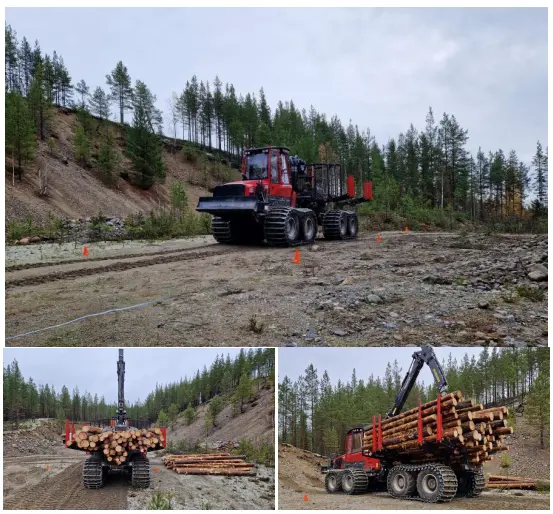
XSCAVE develops smart software to make machines in Earth-Moving, Forestry, and Urban Logistics more autonomous, efficient, and environmentally friendly. We focus on enabling machines—like excavators or outdoor delivery robots—to sense and adapt adapt to their environment automatically.
Heavy machines play a critical role in sectors like Earth-Moving, Forestry, and Urban Logistics. By making these machines more autonomous, we can boost productivity, reduce environmental impact (such as fuel use and soil damage), and help address labour shortages. Autonomy isn’t just about machines moving on their own—it’s about intelligent systems that understand and respond to the complex environments they operate in.
Our goal is to significantly advance machine autonomy in challenging outdoor settings, in collaboration with industry leaders like Novatron, Komatsu, and Clevon.
There is a shortage of annotated data for excavation, forwarding, and wheeled-vehicle navigation—especially data that covers diverse terrain contact conditions. While simulators can help address this gap, creating fast and high-fidelity simulations of terrain dynamics and contact remains an unsolved problem.
Learned perception-to-action models must be safe by design to prevent damage to machines, operators, or others on the worksite. However, ensuring safety within neural network-based decision-making is still a difficult challenge.A short description of the benefit.
Models trained in simulations or using limited real-world demonstrations may not perform reliably in practice, due to differences between simulated and real-world physics and sensing. Bridging this gap is especially hard when terrain-machine contact is involved.
To reduce operator workload and training time, autonomy should function with minimal supervision. For this to succeed, the learned models must behave in ways that are trustworthy and easily customizable to human preferences.
The University of Tartu, founded in 1632, is Estonia’s leading research-intensive university known for its excellence in science, technology, and innovation, and serves as the coordinator of this project, bringing together international expertise to foster academic collaboration and technological development.
Algoryx Simulation AB is a Swedish software company specializing in high-fidelity, real-time physics simulation tools for engineering, robotics, and training applications.
Czech Technical University in Prague (CTU) is the oldest technical university in Europe, founded in 1707, and is renowned for its excellence in engineering, technology, and applied sciences.
Tampere University is Finland’s second-largest research university, renowned for its interdisciplinary focus on technology, health, and society.
Funded by the European Union. Views and opinions expressed are however those of the author(s) only and do not necessarily reflect those of the European Union or the HADEA. Neither the European Union nor the granting authority can be held responsible for them.